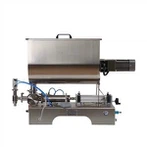
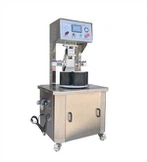
The vibrating feeder uses the rotation of the eccentric mass in the vibrator to generate centrifugal force, so that the movable parts such as the screen box and the vibrator make forced continuous circular or approximate circular motion. The materials follow the screen box for continuous throwing motion on the inclined screen surface, and continuously and uniformly send the materials to the receiving port.
When the bottom plate and the materials move forward, the materials in the silo will fill up the space in the machine body. When the bottom plate moves backwards, the materials on the bottom plate cannot return and are blocked and discharged, so as to realize the feeding. The feeding amount can be adjusted by changing the amplitude and frequency of the movement of the bottom plate and the height of the discharge gate. The feed rate is generally within 40 tons/hour. This type of feeder is suitable for medium and small-size materials, and there are mainly two types: trough type and pendulum type. The bottom plate of the trough feeder is flat and reciprocates during work. The bottom plate of the pendulum feeder is arc-shaped, hinged on the body, and the bottom plate swings when working.

The feeder is composed of a rotatable disc, a guide sleeve and a scraper. The materials in the silo are stacked on the disc with wear-resistant liner through the guide sleeve, the disc rotates, and the material is scraped out and fed by the scraper. The feeding amount can be changed by adjusting the position of the scraper or the height of the guide sleeve. The diameter of the disc is generally less than 3 meters, and the speed does not exceed 10 rpm. The disc feeder runs smoothly and reliably, it is more convenient to adjust the feeding amount, consumes less energy, but the structure is relatively heavy and it is suitable for powdery and granular materials with less viscosity.
Some feeders consist of a casing and an impeller. The inlet and outlet ports at the upper and lower ends of the casing are respectively connected with the silo and the receiving equipment. When the impeller rotates around the horizontal axis, the material falls between the compartments of the impeller, and after half a rotation of the impeller, it is discharged into the receiving equipment. The pressure equalizing pipe can vent the high pressure from the cavity before entering the material area, so as not to be unable to feed the material when it reaches the material area. The feed rate can be adjusted by changing the impeller speed. The diameter of the impeller is generally below 500 mm, and the speed does not exceed 45 rpm. This kind of feeder has a relatively simple structure, small size, light weight, good airtightness when feeding, and is suitable for small particle size and powdery materials.