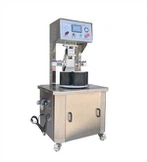
1. Suction sticking method (or air suction method): This is the most common labeling technology. When the label paper leaves the conveyor belt, it is distributed on the vacuum pad, which is connected to the end of a mechanical device. When the mechanical device is stretched to the point where the label and the package are in contact, it shrinks back, and the label is attached to the package at this time. This technology reliably achieves correct labeling with high accuracy. This method is very suitable for top or side labeling where the height of the product package has a certain change, or for side labeling of packages that are difficult to move. Yes, but its labeling speed is slow and the labeling quality is average.
2. Blow sticking method (or jet method): Some of the operation modes of this technology are similar to the above suction sticking method, which is to place the label on the surface of the vacuum pad and fix it until the sticking action starts. However, in this method, the vacuum surface remains immobile, and the label is fixed and positioned on a "vacuum grid". The "vacuum grid" is a plane with hundreds of small holes on it. The small holes are used to maintain the formation of "air Jet". From these "air jets", a stream of compressed air is blown out, and the pressure is very strong, which moves the label on the vacuum grid and makes it stick to the packaged goods. This is a complex technology, it has high accuracy and reliability.
3. Wipe and paste method (or brush paste method): This method is also called the synchronous labeling method. When labeling, when the front edge of the label is attached to the package, the product immediately takes the label away. In this kind of labeling machine, this method can only be successful when the passing speed of the package is consistent with the label dispensing speed. This is a technology that needs to maintain continuous operation, so its labeling efficiency is greatly improved, and it is mostly suitable for high-speed and efficient automated packaging production lines.